Quickstart
In a few minutes, you'll go from zero to accelerated LLM inference on AMD hardware. The entire workflow is containerized; no host dependencies to manage, no hours spent compiling frameworks from source.
Supported Hardware
daisy-vllm runs on AMD ROCm-supported GPUs:
| Series | Supported Architectures | Example GPUs |
|---|---|---|
| AMD Instinct™ | gfx90a, gfx942 | MI210, MI250, MI250X, MI300X |
| Radeon™ Pro & Desktop | gfx1100, gfx1101, gfx1102 | Radeon RX 7900 XTX / 7900 XT (RDNA 3) |
| Next-Gen Hardware | gfx1200, gfx1201 | RDNA 4 development targets |
Recommendation: For production workloads, AMD Instinct MI210/MI250/MI300X GPUs are recommended. For development, RDNA 3 desktop GPUs work well.
Quick Setup
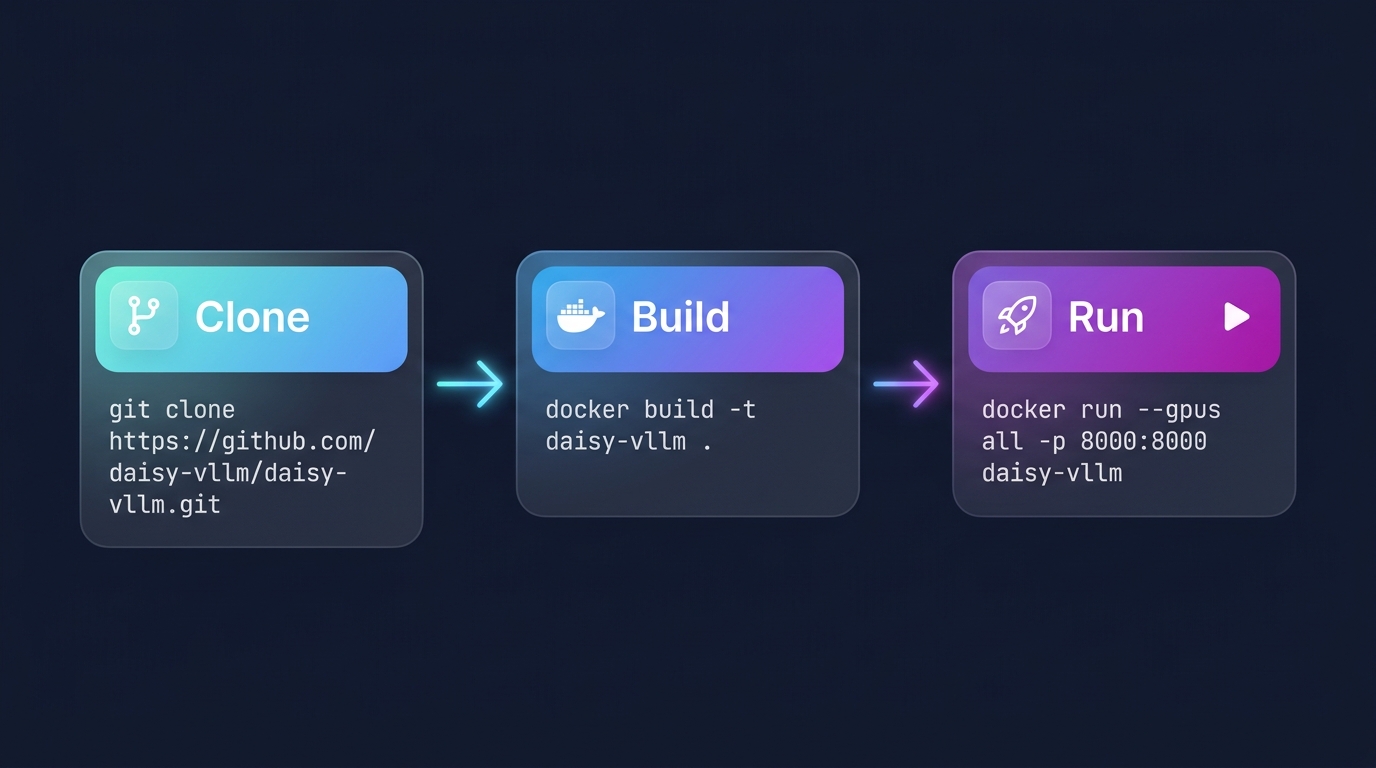
Run the following commands in sequence to go from zero to your first accelerated inference:
# 1. Clone the repository with compiler submodules
git clone --recursive https://github.com/daisytuner/daisy-vllm.git
cd daisy-vllm

# 2. Initialize environment configuration
cp .env.example .env

# 3. Build the docker image
make build-docker-image

# 4. Launch the container environment
make shell

# 5. Install the editable package
pip install -e .

# 6. Compile docc backend
make build-docc

# 7. Run your first accelerated benchmark
python benchmark/qwen2_poem.py -dt bfloat16 -e daisy-vllm -p
Expected Output
When the benchmark runs, you'll see daisy-vllm initialize the engine, load the model, capture piecewise CUDA graphs through the docc compiler, and generate an accelerated response:
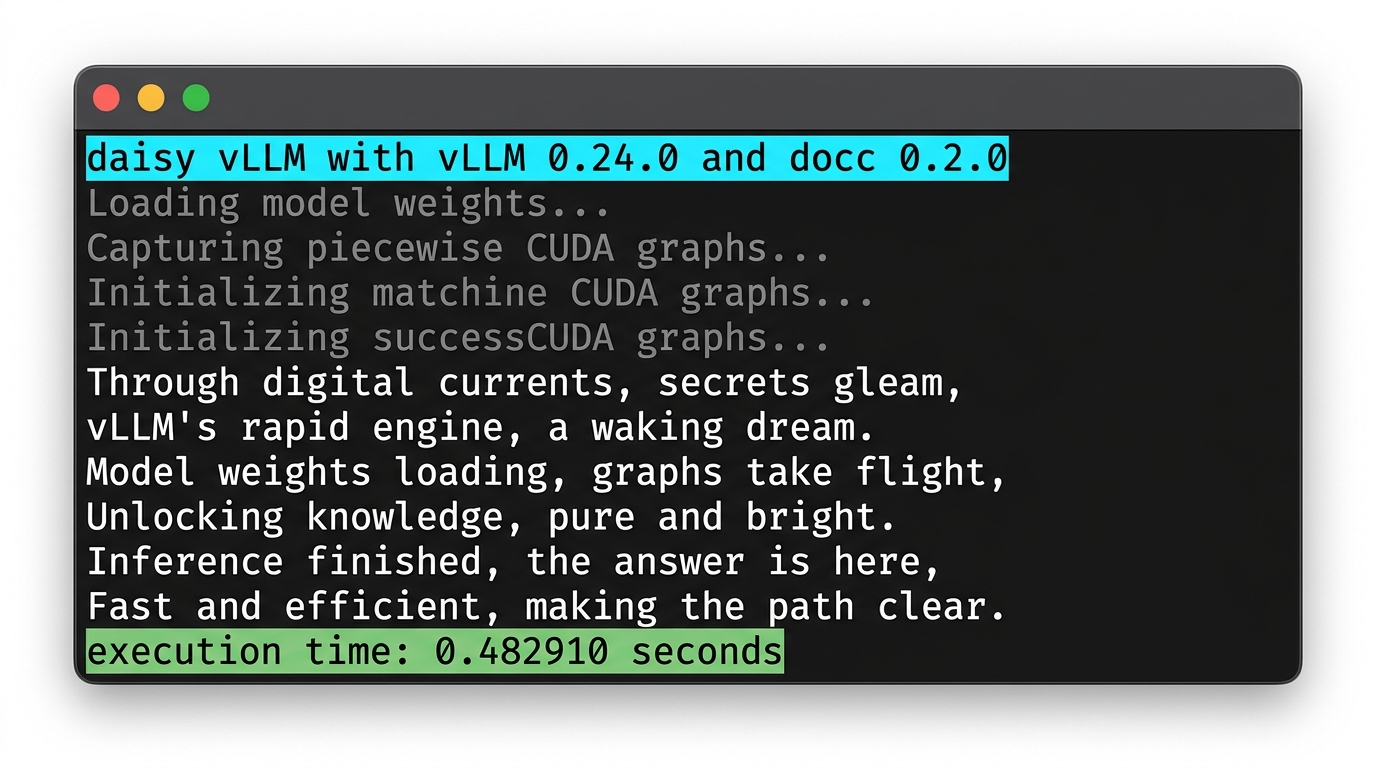
That's it. You just ran accelerated inference with docc-compiled MLP kernels on an AMD GPU.
What Just Happened?
Behind those few commands, a sophisticated compilation pipeline executed:
- Graph Capture: vLLM's piecewise CUDA graph mode captured the model's execution graph, splitting it at
docc_mlpboundaries. - MLP Isolation: The SwiGLU MLP layers (Gate/Up projections + SiLU activation + Down projection) were extracted as separate subgraphs.
- docc Compilation: These MLP subgraphs were lowered through the
docccompiler, which generated fused, shape-specialized ROCm kernels tuned for your GPU architecture. - Hybrid Execution: The final model runs a hybrid graph. Attention and norms on Torch Inductor, MLPs on compiled
docckernels.
The result? The 83% of GPU time that was spent on generic GEMM library calls is now running through optimized, fused kernels.
Deep Dive: Want to learn why MLP layers bottleneck GPU inference and how
doccfuses these operations? Read Architecture & How It Works.
What's Next?
- Architecture & How It Works: Deep dive into the MLP bottleneck and compiler integration.
- Workload Benchmarking: Compare performance across
vllm,vllm-full, anddaisy-vllm. - Correctness Verification: Validate compiled model numerical fidelity against eager PyTorch.
- Supported Models & Precisions: View validated checkpoints, planned models, and
DaisyLLMparameters. - Frequently Asked Questions (FAQs): Solutions for common ROCm and permission issues.